
South Brunswick Previous Residents Sources
Past residents are best researched as a timed trail. Current parcel data establishes the land unit. Deeds show recorded transfers. Directories, censuses, and newspapers add household or community context for the years between transfers. South Brunswick has several good routes, but none is a continuous occupant list for every address. Begin with the source closest to the period in question and record both the date and the source's limits.
| Source | Years It Covers | Where Held | What It Shows |
|---|---|---|---|
| Current proof book and parcel data | Current annual lists, including the inspected 2025 proof book | South Brunswick Assessor, tax maps, and county GIS | Owner and mailing address separate from situs, plus block, lot, assessment, and parcel fields |
| Middlesex County deed index | Current page states deeds from 1929; a 2022 notice describes digitization back to 1923; older county records date from 1683 | County online search, Clerk books, and microfilm | Grantor, grantee, recording date, consideration, legal description, and book or page references |
| State Archives county deed microfilm | County deeds through 1900 | New Jersey State Archives microfilm room, Trenton | Older grantor-grantee indexes and deed copies |
| Regional New Brunswick directory | 1890, pages 433-516 | South Brunswick Public Library, Archival Box 67, Cabinet 1 | Regional name and address clues, with original-volume inspection required |
| Regional Polk and Richmond directories | 1928-1929, then listed Polk runs from 1930-31 through 1980 | New Jersey State Library books and reels | Regional surname, business, and household or address entries when the locality is included |
| Federal and New Jersey censuses | Federal 1790-1950 under the 72-year rule; New Jersey 1855-1915 | Archives, NARA, FamilySearch, and library databases | Household snapshots; some early New Jersey schedules are incomplete |
| Local newspapers and Deans minutes | Forum 1939-42; Central Post 1959-99; Sentinel 1995-2017; South Brunswick Post 1999-2015; Deans minutes 1884-1948 | Digifind-IT and South Brunswick local history | Obituaries, notices, local events, attendees, and community links |
For a recent transfer, use the current parcel and deed row first. For a nineteenth-century question, the State Archives, the 1890 regional section, historical censuses, and county books are stronger starting points. Building permits are a separate route: South Brunswick has no verified public online permit-by-address portal, so use the Building or Planning counter or an OPRA request for releasable records.
South Brunswick Parcel-to-Deed Start
Begin with the current tax proof book, tax map, or county parcel layer. Record the block, lot, qualifier, legal description, current owner, deed book and page, and the property's situs address. The South Brunswick proof book separates the owner mailing address from the property location. That distinction is essential: a mailing address can belong to an owner, trustee, or estate and does not establish that the person lives at the parcel.
The New Jersey Property Explorer supports address, county, municipality, block, and lot searches. Middlesex parcel data can supply a PIN, old block or lot, sale date, deed book and page, acreage, year built, and other tax fields. Save the layer's update date as well. Parcel geometry helps locate the land, while a recorded deed remains the better source for the title chain.
Note: Use South Brunswick Township as the municipality and keep a mailing address separate from the parcel's physical situs address.
South Brunswick Records and Deed Cutoffs
The Middlesex County land-record search currently describes online deeds from 1929, mortgages from 1950, and other documents from 1958. A County announcement from April 2022 says older deeds were digitized and made searchable and viewable back to 1923. Those statements should be read as different published descriptions, not silently combined into one guarantee. Before relying on a 1923-1928 result, confirm that the needed year is available in the live interface.
The County land-record launch page is the starting point for the online deed chain.
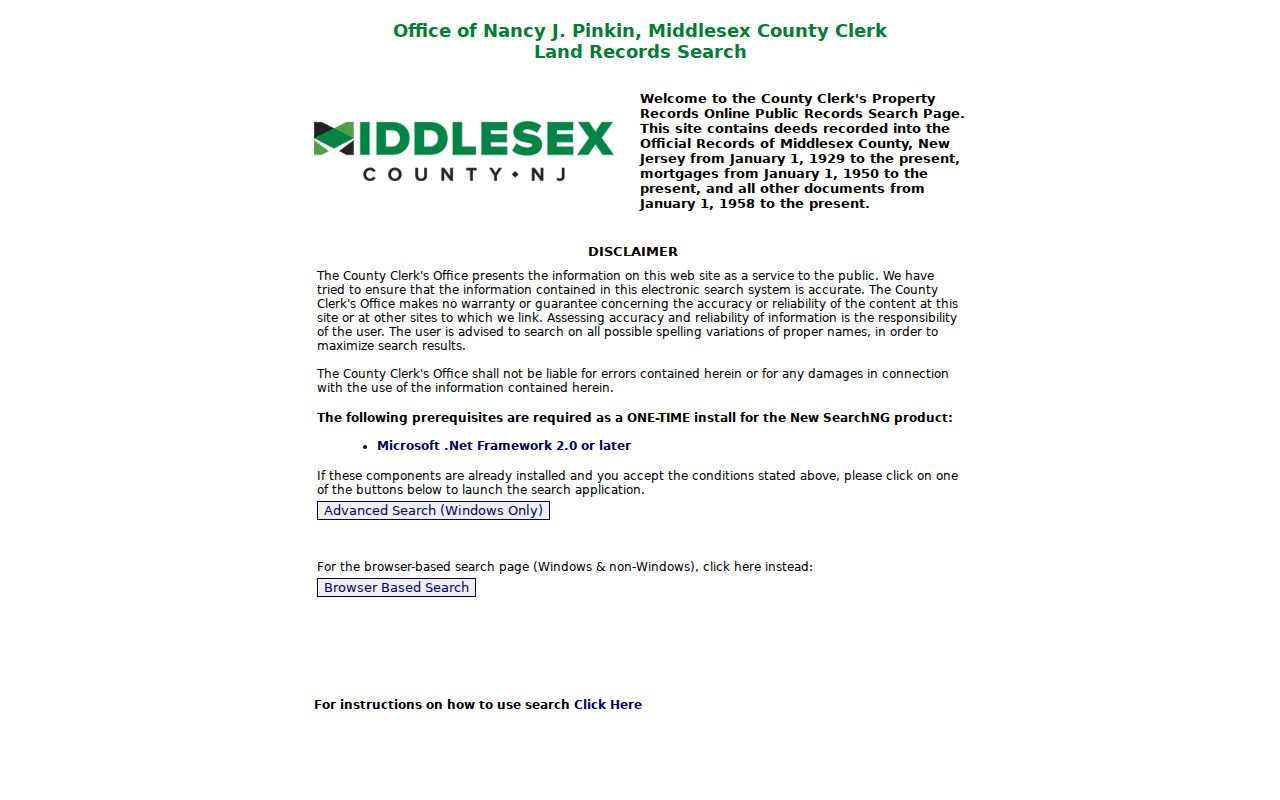
When online coverage stops, the record has not vanished. Middlesex County has land recordings on file since 1683, and earlier books or microfilm remain a County Clerk route. The State Archives adds county deed microfilm through 1900. The two custodians are a bridge across time, not interchangeable copies of the same searchable web index.
Tracing a Middlesex County Deed Chain
A deed chain follows the parcel, not a guessed street-number history. Find the most recent deed from the current block, lot, qualifier, legal description, deed book and page, or owner name. Read the transfer itself for the grantor, grantee, prior reference, and legal description. Then search the grantor as the earlier grantee. If a lot number or qualifier changes after subdivision, follow the legal description and cited prior deed instead of assuming that the address stayed unchanged.
- Capture the current parcel's block, lot, qualifier, legal description, and deed reference from the tax or GIS record.
- Find the current deed in the County Clerk index by book and page, party, municipality, or block and lot.
- Read the grantor, grantee, recording date, and prior-deed reference in the document.
- Search the grantor as a prior grantee, then repeat the same transfer check backward.
- At the web cutoff, request or inspect older County Clerk books or microfilm and then use State Archives deed microfilm where it reaches the needed era.
- Grantor
- The person or entity conveying an interest in the recorded deed.
- Grantee
- The person or entity receiving the interest in that deed.
- Chain of title
- The sequence of recorded transfers connected through a particular parcel.
- Legal description
- The land description used in a deed, such as a lot and block or metes and bounds. It is safer than a street label when an address has changed.
South Brunswick Past Residents in Census Snapshots
Deed parties identify a recorded property trail, but they do not identify every household member. Pair a dated directory entry with the nearest census. Federal schedules are publicly available through 1950 under the 72-year rule. New Jersey state census years run from 1855 through 1915, with incomplete 1855, 1865, and 1875 schedules. Census place and boundary context should be noted before matching an old household to a current address.
Use a directory name, village, or road as a first locator, then compare the household as a whole. Ages, relationships, birthplace, and occupation can help distinguish two people with the same name. Do not reverse that logic by claiming that a matching surname proves address continuity. A changed road name, boundary, post-office identity, or omitted directory listing may require a new search path.
- Start with a directory or newspaper date tied to a person, village, or road.
- Check the nearest federal or New Jersey census snapshot for the household composition.
- Compare the township, post office, and adjacent names with the deed or map context.
- Search the next directory or newspaper period for a move, marriage, death, or organization notice.
South Brunswick Previous Residents in Directories
The 1890 New Brunswick directory section and later regional Richmond and Polk volumes are household leads, not proof of occupancy for every address. Exact South Brunswick inclusion varies by year and title. Search the book's name, street, classified, and place indexes where present, then verify the entry's format from that volume's front matter. No official scan established a uniform spouse, work, residence, or owner mark for the local material.
The full publisher runs, shelf location, and reading cautions are collected on the South Brunswick Directory Book page. For an address trail, record the volume title, date, page, locality heading, and every spelling variation used. This preserves a clear gap between what a regional directory actually reports and what later deed or census records may suggest.
The Digifind-IT archive can fill some gaps with newspapers: Forum, Central Post, Sentinel, and South Brunswick Post appear in the documented runs. Deans Sunday School minutes from 1884-1948 are another local name source, although attendees are not the same as an address list.
South Brunswick Previous Residents and Boundaries
South Brunswick's present boundary dates to 1919. Cranbury separated from the southern part of the township in 1872, boundaries changed again in 1885, and Plainsboro separated in 1919. An older deed, census, or directory entry may therefore use a larger South Brunswick context, a different municipality, or an older post-office community. This is a records-geography issue, not proof that a historic address was renumbered.
No official source located a South Brunswick street-number renumbering year. No verified township-specific Sanborn map set was found either. Use old road aliases, Dayton, Deans, Kendall Park, Kingston, Monmouth Junction, neighboring owners, block and lot, and the legal description to bridge a questionable address. A map can help interpret a place, but it should not be substituted for the actual deed trail.
South Brunswick House-History Trail Endpoints
The South Brunswick Public Library's Historical Houses materials cover Davidson Mill, Dayton, Deans, Kendall Park, Kingston, and Monmouth Junction. The library also has a Kingston Lane land-ownership study running from 1907 to the present. These materials make useful house-history companions to deeds, maps, census records, and photographs. Ask the Local History Librarian about tax maps, Ceil Leedom files, obituaries, newspaper keywords, and the 1890 directory section when arranging a visit.
For a trail that ends with death, estate settlement, or a transfer from an estate, search the library obituary finding aid and digitized papers, then check the Middlesex Surrogate estate index. The portal warns that its index is not the entire official file. The documented search fee is $10 and copies are $3 per page; request or copy the underlying file when an index result matters. A will, administration, tax sale, or estate deed can explain why an owner changes without proving every person who lived there.
The New Jersey State Archives genealogical collections search supplies another route for older deeds, probate, census, and related historical records.
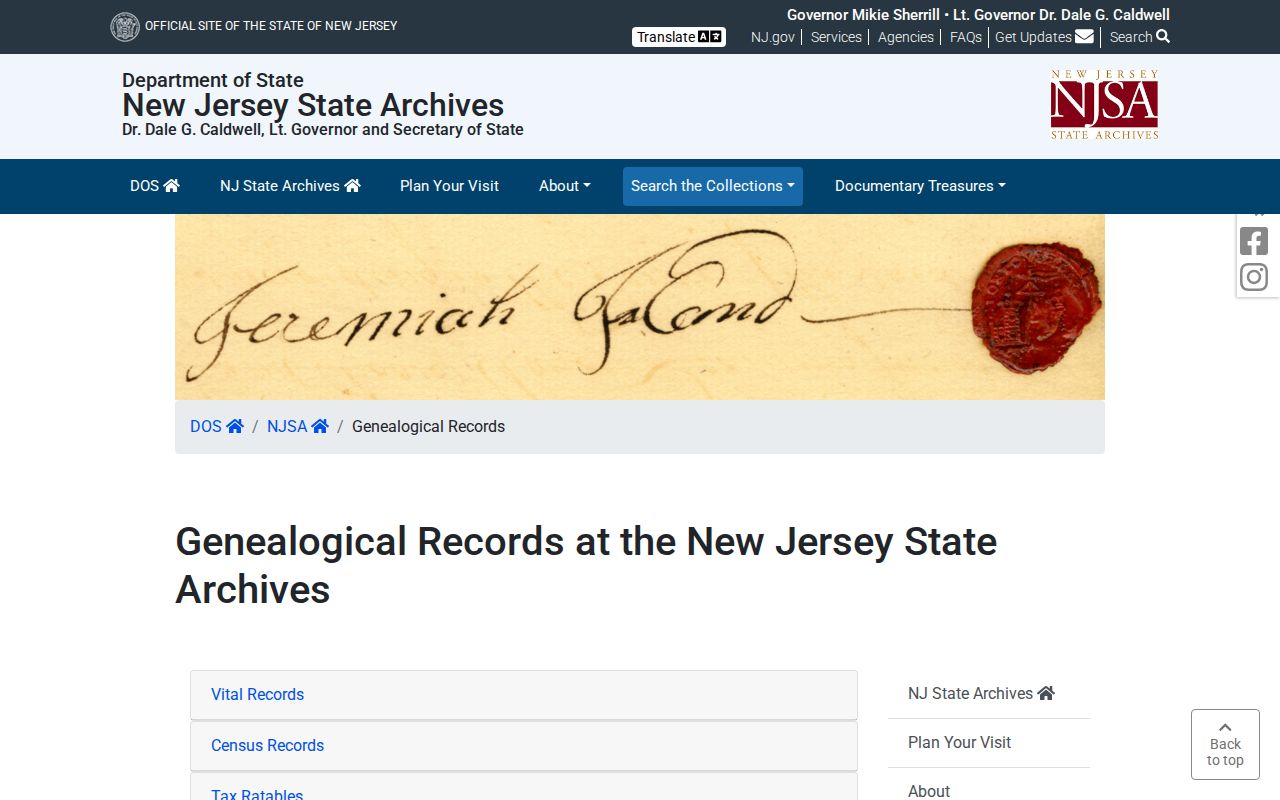
The archives are especially useful when the County Clerk web search no longer reaches the needed period. Keep the parcel details and exact date range with every request.
Lawful personal research. South Brunswick previous-resident work fits family history, estate questions, and house history. Do not use names or addresses to stalk, harass, threaten, or track a living person.